PCSL Shooting Guide 2026: The Complete Beginner Guide to Practical Competition Shooting League
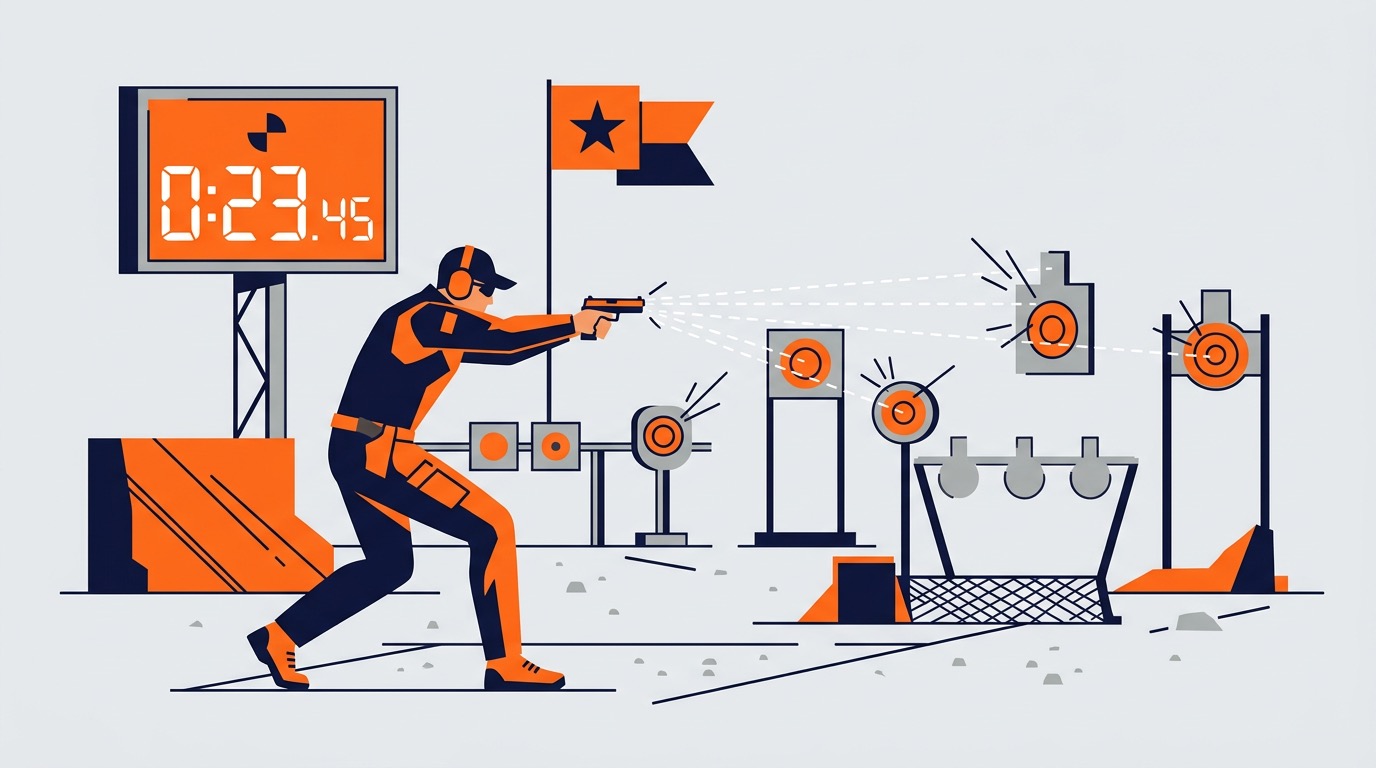
What Is PCSL?
If you’ve been paying attention to the competitive shooting world over the past few years, you’ve probably heard people buzzing about PCSL — the Practical Competition Shooting League. Founded in 2021 by Leograndis, PCSL has quickly carved out a reputation as one of the most exciting and accessible practical shooting sports in North America. Their tagline says it all: “The Future of Competition Shooting.”
So what makes PCSL different from the other organizations you already know? In short, PCSL takes the best elements of USPSA, IDPA, and 3-Gun and blends them into a streamlined, modern format. It was designed from scratch for today’s shooter — someone who wants challenging, fair competition without drowning in a 200-page rulebook or dealing with organizational politics.
When I first walked into a PCSL match, what struck me immediately was the vibe. It felt less like a formal sanctioned event and more like a group of skilled shooters who genuinely wanted to push each other. The stages were creative, the rules were intuitive, and I didn’t need a law degree to understand the scoring. If you’ve ever been frustrated by the complexity of other organizations, PCSL might be exactly what you’re looking for.
💡 New to practical shooting entirely? Start with our Complete Guide to Practical Shooting for a broad overview before diving into PCSL specifics.
Why PCSL Is Growing So Fast
There are a lot of shooting sports organizations out there, so why is PCSL gaining traction faster than almost anything else? A few reasons stand out.
Open-Source Ruleset
This is the big one. PCSL’s ruleset is completely open-source. Any club, range, or group of shooters can adopt the PCSL rules, modify them for their local needs, and run matches — all without paying affiliation fees or getting approval from a national board. There’s no bureaucracy standing between you and a match. If your local club wants to host a PCSL event this Saturday, they just… do it.
Compare that to organizations where you need sanctioning, insurance arrangements, and annual club dues before you can even think about posting a match. The open-source model removes friction, and that’s why you’re seeing PCSL pop up in places where other sports haven’t been able to get a foothold.
Simplified, Modern Rules
PCSL was written in 2021, not in the 1970s. The rules reflect how people actually shoot today. There are no legacy provisions that exist because “that’s how we’ve always done it.” Everything is designed to be intuitive — if something makes sense on the range, it probably aligns with the PCSL rulebook.

Focus on 2-Gun
While PCSL offers pistol-only and rifle-only formats, their flagship is the PCSL 2-Gun match — pistol and rifle on the same stage. This combines the best parts of 3-Gun competition without requiring a shotgun (which many shooters find to be the most expensive and least practical firearm to maintain for competition). If you already own a pistol and a rifle, you’re ready for PCSL 2-Gun.
No Club Affiliation Required
Want to shoot a PCSL match? Just show up, register, and compete. You don’t need to be a member of any club or national organization. There’s no classification system to worry about, no membership card to carry. Your performance on match day is all that matters.
PCSL Scoring System: Points Per Second (PPS)
Understanding the scoring system is crucial before you step onto the line. PCSL uses a Points Per Second (PPS) system that will feel familiar if you’ve shot USPSA or IPSC, but with an important simplification.
How PPS Works
The formula is straightforward:
PPS = Total Points Earned / Time (in seconds)
You engage all the targets on a stage, and your total points are divided by the time it took you to complete the stage. Higher PPS means better performance. This is essentially the same concept as USPSA’s Hit Factor, but PCSL calls it PPS to keep the language clean and consistent.
Everyone Scores Minor
Here’s where PCSL diverges from USPSA in a meaningful way: every division scores minor power factor. There’s no major/minor distinction. This means you don’t gain a scoring advantage by shooting a bigger caliber. A 9mm shooter and a .45 ACP shooter earn the same points for hitting the same zone.
This is a deliberate design choice. It keeps the playing field level and removes the incentive to chase major power factor loads that are harder to control and more expensive to shoot. You can focus on shooting fast and accurate with whatever caliber you’re most comfortable with.
Point Values on PCSL Targets
Here’s where PCSL gets really interesting — the point values on PCSL targets:
- K-Zone: 10 points (more on this in the next section)
- A-Zone: 5 points
- C-Zone: 3 points
- D-Zone: 1 point
- Miss: 0 points (plus a penalty)
The K-Zone is the game-changer. That 10-point hit is worth twice an A-zone, which means precision shooters who can consistently nail the K-Zone will have a massive scoring advantage — even if they’re slightly slower.

The K-Zone Target: What Makes PCSL Unique
If there’s one thing that defines PCSL as a sport, it’s the K-Zone target. This is PCSL’s proprietary target design, and it changes the way you think about practical shooting.
What Is the K-Zone?
The K-Zone is a small, high-value scoring area located in the center of the PCSL target. Think of it as a bullseye within the A-zone. At 10 points per hit, it’s the highest-value zone on the target and the one that separates good shooters from great ones.
The PCSL target is also more compact than standard USPSA or IDPA targets. The overall silhouette is smaller, and the scoring zones are tighter. This means the skills that worked for you on a generous USPSA target may not translate directly — you need to be more precise.
Why the K-Zone Matters
The K-Zone fundamentally changes your shooting strategy. In USPSA, many competitive shooters train to hammer fast A-zone hits and move on. The difference between an A-zone and a C-zone is only 1-2 points, so speed almost always wins over precision.
In PCSL, the math is different. The gap between a K-Zone hit (10 points) and an A-zone hit (5 points) is enormous. If you’re facing a stage with 12 targets and you nail all K-Zones versus all A-zones, that’s a 60-point difference — easily enough to change your stage placement even if the K-Zone shooter was a full second slower.
This rewards the shooter who can balance speed and accuracy at a higher level. You can’t just spray and pray your way through a PCSL match. Every shot has to count, especially those aimed at the K-Zone.
Training for the K-Zone
If you’re coming from USPSA or IDPA, you’ll want to tighten up your accuracy standards. Here’s a practical approach:
- Start at 7 yards and shoot groups at a 3-inch circle (approximately K-Zone size)
- Use a shot timer to track your split times while maintaining K-Zone accuracy
- Gradually increase distance to 10, 15, and 20 yards
- Practice transitioning between targets while keeping your point of aim tight
💡 Our AirsoftShotTimer app is perfect for K-Zone accuracy drills. Set par times and track your splits as you work on tightening your groups. Check out our Shot Timer Training Guide for structured drill programs.
PCSL Divisions Explained
PCSL offers six divisions, each designed for a different type of shooter and equipment level. This is one of the most thoughtfully designed division structures in practical shooting.
Competition Division
This is the open-class equivalent — the division for race guns and maximum modifications. If you’ve got a tricked-out 2011 with a compensator, frame-mounted optic, and extended magazine well, this is where you belong. Competition division is where you’ll see the fastest times and the most specialized equipment.
Typical Equipment: Open-class 2011s, compensated pistols, frame-mounted red dots, extended magazines.
Practical Division
Practical is designed for shooters using real-world, duty-style gear. Think of it as the “what you’d actually carry” division, but with a competition twist. Holsters must be practical (not race holsters), and equipment should reflect what a professional might use on duty.
Typical Equipment: Stock or lightly modified service pistols, duty-style holsters, standard capacity magazines.
Practical Optics Division
This is Practical division plus a slide-mounted red dot sight. If you’ve got a modern pistol with an optic cut and a quality red dot, Practical Optics is your home. It bridges the gap between iron-sight Practical shooters and fully kitted-out Competition shooters.
Typical Equipment: Slide-mounted red dots (RMR, SRO, Holosun 509T, etc.), standard holsters, service-grade pistols.
💡 Want to learn more about pistol optics? Check out our Complete Pistol Red Dot Sight Guide.

Actual Carry Pistol (ACP) Division
This might be the most interesting division in PCSL. Actual Carry Pistol is exactly what it sounds like — you shoot with whatever you’re carrying right now. Your everyday concealment holster, your compact or subcompact pistol, your standard carry ammo capacity. This division tests real-world defensive readiness in a competition format.
If you’ve ever wondered how fast you can actually draw and shoot from your concealment rig under pressure, ACP will give you a very honest answer.
Typical Equipment: Compact pistols (Glock 19, SIG P365, S&W Shield Plus), IWB or AIWB holsters, standard capacity carry magazines.
Irons Division
Irons is for shooters who prefer iron sights — no red dots allowed. If you believe in mastering the fundamentals before adding technology, or if you simply prefer the clean sight picture of good iron sights, this division is for you.
Typical Equipment: Any pistol with iron sights only, standard competition or duty holsters.
Coachable Shooter Division
This is one of the most thoughtful additions to any shooting sport. Coachable Shooter is specifically designed for brand-new shooters who are attending their first few matches. In this division, an experienced shooter can stand behind you and provide coaching during your run — telling you where to go, reminding you about targets, and helping with safety.
This removes the biggest barrier to entry for new competitors: the fear of looking lost on a stage. If you’ve never shot a match before, Coachable Shooter lets you learn the ropes without the pressure of figuring everything out alone.
DA/SA and SAO Handling Rules
PCSL has specific rules for DA/SA (double action/single action) and SAO (single action only) pistols. If you’re running a CZ Shadow, Beretta 92, or 1911-pattern gun, make sure you review the PCSL rulebook for start conditions and decocking requirements. The rules are designed to be safe and practical, but they differ from what you might be used to in USPSA or IDPA.
PCSL Match Types
PCSL offers several match formats to keep things interesting and accessible.
PCSL Pistol
The purest format — handgun only. Stages are designed around pistol engagement distances and challenges. If you’re new to PCSL, starting with a pistol match is the easiest way to learn the rules and scoring without worrying about rifle transitions.
PCSL 2-Gun
This is PCSL’s flagship format and what most people think of when they hear “PCSL.” Stages incorporate both pistol and rifle, requiring you to transition between platforms during a single stage. You might start with rifle on distant targets, transition to pistol for close work, then go back to rifle — all while the clock is running.
2-Gun is where PCSL really shines. It combines the excitement of multi-gun competition with a simpler equipment list than 3-Gun. No shotgun means one less gun to buy, maintain, and reload. The 2025 PCSL 2-Gun National Championship highlighted just how far this format has come in a short time.
PCSL Pistol Caliber 2-Gun
A unique variation where your rifle must be chambered in a pistol caliber (typically 9mm). This is great for shooters who own a pistol caliber carbine (PCC) and want to use it in a multi-gun context. It also keeps ammunition costs down since you’re buying only one caliber.
PCSL Rifle
Rifle-only stages that test precision and speed with a long gun. These matches typically feature longer engagement distances and more complex positional shooting requirements.

PCSL vs USPSA vs IDPA: Key Differences
If you’re coming from another shooting sport, you’re probably wondering how PCSL stacks up. Rather than burying you in comparison tables, let me walk through the practical differences that matter most on match day.
Scoring Philosophy
USPSA uses Hit Factor with major and minor power factor distinctions. IDPA uses a time-plus system where penalties add seconds to your raw time. PCSL uses PPS with no major/minor distinction — everyone scores the same regardless of caliber. This makes PCSL scoring the simplest of the three to understand and the fairest across equipment levels.
Target Design
USPSA targets are relatively generous, especially in the A-zone. IDPA targets have a smaller down-zero area. PCSL’s K-Zone target is the most demanding of all three — the high-value zone is compact, and the scoring gaps between zones are large. If you can consistently nail K-Zones, you’re a genuinely accurate shooter.
Organization Structure
USPSA requires membership ($65/year) and operates through affiliated clubs. IDPA also requires membership and club affiliation. PCSL requires nothing — the rules are open-source, there are no membership fees, and any club can run a match. This is probably the single biggest reason for PCSL’s rapid growth.
| Feature | PCSL | USPSA | IDPA |
|---|---|---|---|
| Membership Required | No | Yes | Yes |
| Scoring System | PPS (minor only) | Hit Factor (major/minor) | Time-Plus |
| Unique Target | K-Zone (10 pts) | A-Zone (5 pts) | Down Zero |
| Multi-Gun Focus | 2-Gun (flagship) | Limited | Not available |
| Rules Access | Open-source | Members only | Members only |
Multi-Gun Integration
USPSA offers multi-gun but it’s separate from their core pistol program. IDPA doesn’t have a multi-gun format. PCSL was built with 2-Gun as a central pillar, which means stage design and rules are optimized for multi-gun from the ground up. For a deeper comparison of shooting sports, check out our IDPA vs USPSA Guide.
Equipment You Need for Your First PCSL Match
One of the best things about PCSL is the low barrier to entry. Here’s what you actually need.
Essential Gear
- Pistol: Any reliable semi-automatic handgun. Glock 17, Glock 19, SIG P320, CZ P-09, S&W M&P — whatever you own and shoot well. If you want handgun recommendations, check our pistol guides.
- Holster: A strong-side OWB holster that covers the trigger guard. For ACP division, your concealment holster works. See our Competition Holster Guide for options.
- Magazine Pouches: At least 2-3 magazine pouches. Our Competition Belt Guide covers setup options.
- Belt: A sturdy gun belt. Inner/outer belt systems are popular for competition.
- Magazines: At least 3-4 magazines for your pistol.
- Ammunition: Bring more than you think you’ll need. 150 rounds of pistol ammo for a typical match is safe. Budget 200 if you want a cushion.
- Eye and Ear Protection: Mandatory at every match. See our Shooting Protection Gear Guide.
For 2-Gun Matches (Additional)
- Rifle: An AR-15 or similar semi-automatic rifle in .223/5.56 is the standard choice.
- Rifle Magazines: At least 3-4 magazines, loaded per stage briefing.
- Rifle Ammunition: 100-150 rounds depending on the match.
- Sling: A quality two-point sling for rifle retention during transitions.
What You Do NOT Need
- A race gun or custom 2011
- A competition-specific holster (your duty or carry holster is fine)
- Membership in any organization
- Prior match experience (that’s what Coachable Shooter division is for)

How to Find and Enter a PCSL Match
Getting into your first PCSL match is straightforward.
Search PractiScore
The easiest way to find PCSL matches near you is through PractiScore — the same platform used for USPSA and IDPA matches. Go to practiscore.com, search for “PCSL” in your area, and browse upcoming matches. Most PCSL matches allow online registration through PractiScore, so you can sign up and pay in advance.
Check Social Media
PCSL has an active presence on social media, particularly Instagram and YouTube. Search for #PCSL or follow Leograndis and PCSL-affiliated match directors. Many local matches are announced through social media or club Facebook groups before they hit PractiScore.
Talk to Your Local Range
If there’s no PCSL match in your area yet, talk to your local range or shooting club. Since the rules are open-source, any club can start hosting PCSL matches with minimal setup. All they need is the rulebook, some PCSL targets, and a timer. You might be the person who brings PCSL to your community.
What to Expect at Your First Match
Arrive early — at least 30 minutes before the scheduled start time. Bring all your gear, check in at registration, and attend the safety briefing. If you’re in Coachable Shooter division, introduce yourself to the match director and they’ll pair you with an experienced coach.
Most matches run a squad format where you rotate through stages as a group. Watch other shooters before it’s your turn, ask questions, and don’t stress about your score. Everyone was new once.
Shot Timer Training for PCSL
A shot timer is your single most important training tool for PCSL. The sport rewards the optimal balance of speed and accuracy, and you can’t find that balance without measuring both.
Essential Drills
K-Zone Precision Drill Set up a single target at 7 yards. Draw and fire 2 rounds, aiming for a 3-inch circle (simulating the K-Zone). Your goal is to keep both hits inside the circle. Start with a 3-second par time and work down to 2 seconds. Track your progress with a shot timer app.
Bill Drill Modified for PCSL From the holster, draw and fire 6 rounds on a single target at 7 yards. In standard USPSA training you’d aim for the A-zone, but for PCSL, push yourself to keep all 6 in the K-Zone. This builds the accuracy discipline that PCSL demands.
Transition Drill Set up 3-4 targets spaced 3-5 feet apart at 10 yards. Engage each with 2 rounds, focusing on smooth transitions while maintaining K-Zone accuracy. Use a par time to add pressure and track improvement over sessions.
2-Gun Transition Drill If you’re preparing for PCSL 2-Gun, practice transitioning from rifle to pistol. Start with rifle at low ready, engage 2 targets, safely sling the rifle, draw your pistol, and engage 2 more targets. Time the entire sequence and work on making the transition smooth and safe.
💡 Download AirsoftShotTimer to run all of these drills at home or at the range. The app tracks your splits, records par times, and helps you measure improvement over weeks of training. It’s the easiest way to prepare for your first PCSL match. Learn more in our Complete Shot Timer Guide.
Target Times for Beginners
Here are some benchmarks to work toward as a new PCSL shooter:
- Draw to first shot: Under 2.0 seconds (from concealment, under 2.5 seconds)
- Split times: 0.25-0.35 seconds between shots while maintaining K-Zone accuracy
- Reload: Under 2.5 seconds (slide lock reload)
- Target transitions: 0.30-0.50 seconds between targets at 10 yards
- Rifle-to-pistol transition: Under 4.0 seconds
Don’t chase these numbers right away. Focus on accuracy first, then gradually increase speed. As the old saying goes: you can’t miss fast enough to win. For a comprehensive training approach, check our Shooting Training Plan Guide.

Common Beginner Mistakes
After watching dozens of new shooters at PCSL matches, these are the mistakes I see most often.
Ignoring the K-Zone
New shooters often treat PCSL targets like USPSA targets — blasting for the A-zone and moving on. Remember, a K-Zone hit is worth double an A-zone hit. Take the extra fraction of a second to aim for the K-Zone. The math will reward you.
Going Too Fast
Speed kills — your score, that is. New shooters get caught up in the excitement and try to match the pace of experienced competitors. You’ll end up with C and D zone hits that destroy your PPS. Slow down, get your hits, and let the speed come naturally. Read our Shooting Mental Game Guide for more on managing match pressure.
Not Practicing Reloads
Magazine changes should be automatic. If you’re fumbling with reloads on match day, you’re losing seconds that no amount of fast shooting can recover. Practice your reloads until they’re muscle memory. Our Magazine Reload Guide covers all the techniques.
Skipping the Walk-Through
PCSL allows stage walk-throughs before you shoot. Use every second of that time. Plan your movement, identify target positions, decide where you’ll reload, and visualize your run. Experienced shooters win matches during the walk-through, not during the run.
Neglecting the Draw
Your draw sets the tone for the entire stage. A fumbled draw costs you a full second or more and shakes your confidence for the rest of the run. Practice your draw stroke with a timer until it’s consistent and smooth.
Forgetting Safety Fundamentals
This should go without saying, but match pressure can make even experienced shooters do dumb things. Know the safety rules cold. Breaking the 180-degree rule, sweeping yourself during a reload, or failing to keep your finger off the trigger during movement will get you disqualified — and could get you or someone else hurt.
Frequently Asked Questions
Do I need to be a member of any organization to shoot PCSL?
No. PCSL has no membership requirement. Anyone can show up to a match, register, and compete. This is one of the biggest advantages of PCSL’s open-source model.
What caliber should I shoot for PCSL?
Since every division scores minor power factor, 9mm is the clear choice. It’s affordable, low-recoil, and gives you the highest magazine capacity. There’s no scoring advantage to shooting anything bigger.
Can I shoot PCSL with my concealed carry gun?
Absolutely. The Actual Carry Pistol (ACP) division is designed specifically for this. Bring your everyday carry pistol and holster, and compete as-is. It’s a fantastic way to test your real-world defensive skills under pressure.
How is PCSL different from 3-Gun?
PCSL 2-Gun uses only pistol and rifle — no shotgun required. This cuts your equipment costs significantly and simplifies logistics. The stages are designed around two-gun transitions rather than three. For a full breakdown of 3-Gun, see our 3-Gun Competition Guide.
I’ve never shot a match before. Where do I start?
Sign up for a PCSL Pistol match and enter in Coachable Shooter division. You’ll get paired with an experienced shooter who will guide you through each stage. Bring your pistol, holster, magazines, ammo, eye and ear protection, and a willingness to learn. That’s literally all you need.
Are there PCSL national championships?
Yes. PCSL held its 2025 PCSL 2-Gun National Championship, and the sport continues to grow with more regional and national events each year. Check PractiScore and PCSL social media channels for upcoming major matches.
Take Your First Step
PCSL is proof that competitive shooting doesn’t have to be complicated, expensive, or exclusive. With its open-source rules, intuitive scoring, and welcoming community, there’s never been a better time to get into practical shooting competition.
Whether you start with a PCSL Pistol match in Coachable Shooter division or jump straight into 2-Gun with your own gear, the experience will make you a better, faster, and more confident shooter. And with the AirsoftShotTimer app in your pocket for dry fire and live fire training, you’ve got everything you need to show up prepared.
Find a match on PractiScore, load up your magazines, and see what you’re made of.
Related Articles
- Complete Guide to Practical Shooting — Overview of all practical shooting disciplines
- USPSA Beginner Guide — Complete USPSA introduction
- IDPA Beginner Pistol Guide — Getting started with IDPA
- IDPA vs USPSA Guide — Comparing the two major organizations
- IDPA Rules Guide — Complete IDPA rules breakdown
- IDPA Divisions Guide — Understanding IDPA division structure
- 3-Gun Competition Guide — Multi-gun competition overview
- IPSC Training Guide — International practical shooting
- Shot Timer App Guide — Train smarter with AirsoftShotTimer
- Pistol Draw Guide — Master your draw stroke
- Shooting Drills Guide — Structured drill programs
- Competition Holster Guide — Choosing the right holster
- Competition Belt Guide — Setting up your competition belt
- Shooting Safety Rules Guide — Fundamental safety principles
- PCSL
- PCSL Shooting
- Practical Competition Shooting League
- Practical Shooting
- Competition Shooting
- PPS Scoring
- K-Zone Target
- PCSL Divisions
- PCSL 2-Gun
- PCSL Pistol
- Shot Timer
- USPSA Alternative
- Shooting Match