Tokyo Marui MP7A1 GBB Complete Guide: Specs, Upgrades & CQB Tactics
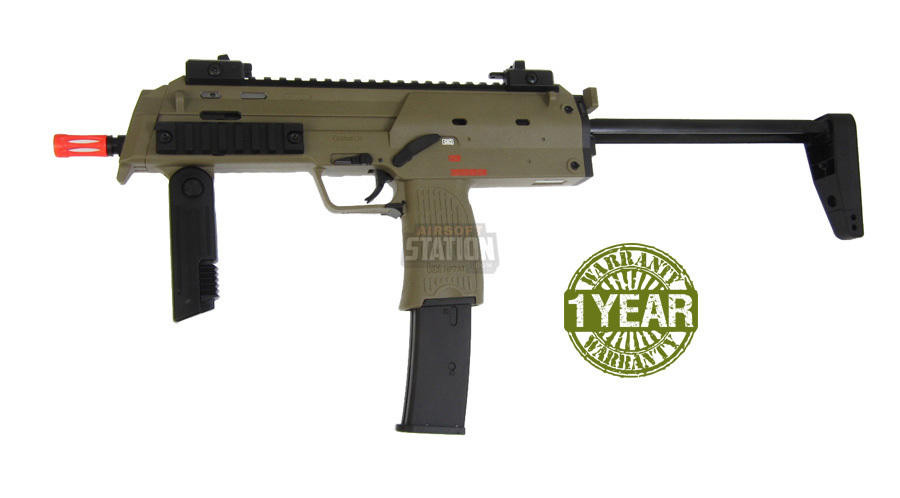
Why the MP7 Is the Ultimate CQB Weapon
If you’ve ever spent a full day at an indoor CQB field, you’ve probably noticed something: the players who consistently outmaneuver everyone in tight corridors aren’t usually carrying full-size rifles. More often than not, they’re running a compact SMG — and the MP7 is one of the most popular choices in that category.
The Tokyo Marui MP7A1 GBB is one of the most iconic MP7 replicas on the airsoft market. It’s not just a good-looking model gun — the punchy blowback kick, compact form factor, and Tokyo Marui’s legendary hop-up accuracy make it a genuinely tactically advantageous weapon in CQB environments. Many players who pick up an MP7 for the first time find it hard to go back to anything else.
This guide covers everything from the real-steel history to the airsoft version’s specs, handling feel, upgrade options, and how to maximize the MP7’s potential in actual gameplay.
The Real HK MP7: Built for Special Forces
To understand why the MP7 is so popular in the airsoft world, we need to look at its real-steel origins. Heckler & Koch began developing the MP7 in the late 1990s in response to a NATO requirement published in 1989 — they needed a submachine gun-type weapon capable of defeating Kevlar body armor.
The first prototype appeared in 1999, entering production in 2001 as the MP7. In 2003, it was redesigned and designated the MP7A1, featuring a reshaped pistol grip, a more compact stock, and standard-issue side-mounted Picatinny rails. The MP7A1 fires the purpose-built 4.6x30mm cartridge — a small-caliber, high-velocity round that can penetrate CRISAT-standard titanium and Kevlar composite armor at 200 meters.
What truly cemented the MP7’s legendary status was its adoption by elite special operations units worldwide. Reports suggest that DEVGRU (SEAL Team Six) operators carried MP7s during the 2011 raid that killed Osama bin Laden. Beyond U.S. special operations, the British SAS, French GIGN, and Austrian EKO Cobra have all added the MP7 to their arsenals. This “chosen by special forces” aura naturally made the MP7 a dream weapon for airsoft players everywhere.
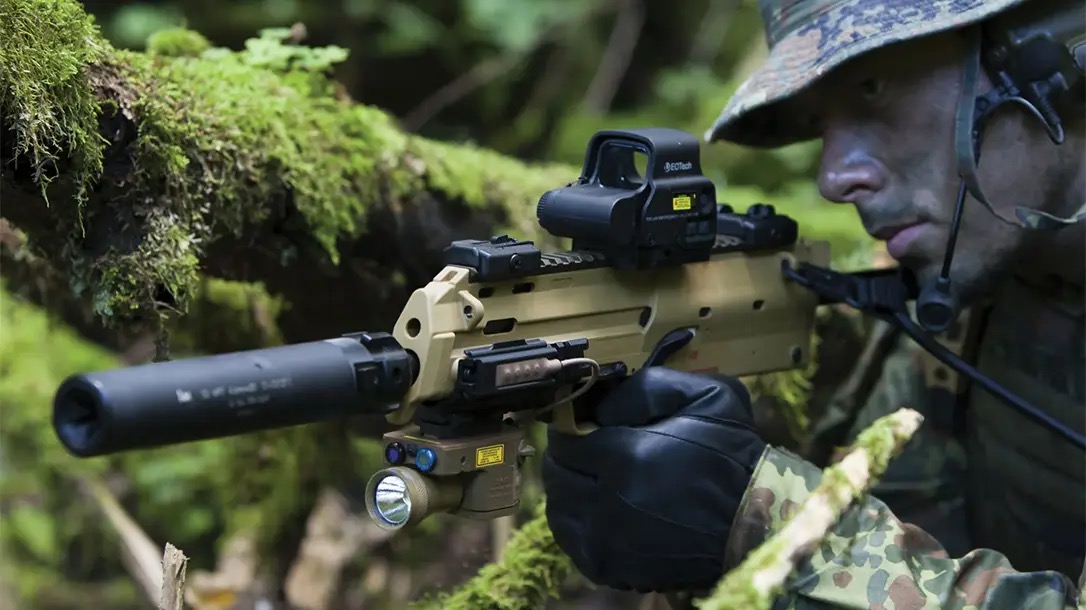
The real MP7 weighs just 1.5 kg empty, measures only 340mm with the stock folded, and extends to 540mm when deployed. It uses a short-stroke piston gas system and fires at up to 950 rounds per minute. These characteristics — lightweight, compact, and packing serious firepower — represent the ideal CQB combination, and Tokyo Marui faithfully captured these qualities in their airsoft version.
Tokyo Marui MP7A1 GBB: Unboxing Experience
Picking up the Tokyo Marui MP7A1 for the first time is a memorable experience. At 2,220 grams, it’s slightly heavier than the real thing, but the weight is evenly distributed — it never feels front-heavy or awkward. The ABS plastic receiver has a surprisingly premium feel, with a matte finish that looks far more refined than you’d expect from polymer construction.
Inside the box you’ll find the gun itself, a 40-round magazine, a cleaning rod, a protective cap, BB rounds, and a suppressor thread adapter. That adapter is a thoughtful inclusion — the MP7A1’s muzzle doesn’t use standard threads, so you need it to mount tracers or suppressors.
Rack the charging handle and the feedback is solid and satisfying. Tokyo Marui designed a brand-new blowback engine for the MP7A1 featuring a 16mm piston that replicates the real gun’s short-stroke piston action. Pull the trigger and the bolt carrier slams backward with surprising violence before snapping forward again. The recoil sensation in your hands is much stronger than the gun’s compact size would suggest. Most people’s first reaction after firing the TM MP7A1 is something like: “How does something this small kick this hard?”
The telescoping stock operates silky smooth — extending it takes just one hand. Fully collapsed, the entire gun is short enough to fit in a large drop-leg holster; fully extended, it provides solid shoulder support for aimed fire. The folding front grip is equally practical — deployed, it naturally positions your support hand closer to the muzzle for better recoil management.
| Spec | Detail |
|---|---|
| Length | 381mm (stock folded) / 586mm (extended) |
| Weight | ~2,220g (with empty magazine) |
| Magazine Capacity | 40 + 1 rounds |
| Muzzle Velocity | 330-350 FPS (0.2g BB / Green Gas) |
| Power System | Gas Blowback (GBB) |
| Fire Modes | Semi-Auto / Full-Auto |
| Hop-Up | Adjustable |
| Construction | ABS receiver / metal internals |
Three Brands, Three Personalities: Which MP7 Is Right for You?
Three major manufacturers produce airsoft MP7s: Tokyo Marui, KWA, and VFC (Umarex licensed). Each has a distinctly different character suited to different types of players.
The Tokyo Marui MP7A1 delivers the best overall shooting experience of the three. It has the strongest blowback kick, the most accurate hop-up system, and the best gas efficiency — maintaining reliable performance even in cooler temperatures. Its biggest drawback is scale: the TM version isn’t a 1:1 replica and runs slightly smaller than the real gun. It also lacks official H&K trademarks since it’s not licensed. If you prioritize performance, neither issue matters much; but if external authenticity is important to you, it might feel incomplete.
The KWA MP7 takes the high-FPS route, pushing around 400 FPS on green gas — making it more viable for outdoor fields. Priced around $250, it’s also more affordable than the TM. However, the KWA version is also undersized, and its hop-up system doesn’t offer the same tuning flexibility. It’s a solid choice for budget-conscious players who primarily play outdoors.
The VFC (Umarex licensed) version’s biggest selling point is its 1:1 true-to-scale dimensions combined with full H&K licensed markings. If you’re after collector-grade external realism, VFC is the only choice. Just be aware that magazines are completely incompatible across all three brands, so verify accessory compatibility before purchasing.
For most CQB players, I’d recommend the Tokyo Marui. Indoor fields typically enforce FPS limits below 350, so raw power isn’t the priority — accuracy, gas efficiency, and blowback feel matter far more in determining real-world performance. The TM’s hop-up system delivers remarkably consistent trajectories at the 20-30 meter engagement distances typical of indoor play, which translates to a genuine tactical advantage in corridor gunfights.
Upgrade Paths
The Tokyo Marui MP7A1’s aftermarket ecosystem isn’t as massive as the Hi-CAPA’s, but all the core upgrade components are readily available. Upgrades generally fall into two categories: internal performance and external accessories.
For internal upgrades, swapping the inner barrel makes the most noticeable difference. The stock barrel is already decent, but installing a Nine Ball or PDI 6.01mm/6.03mm precision barrel significantly improves shot-to-shot consistency, especially beyond 25 meters. Pair it with a Maple Leaf hop-up bucking for even better BB spin stability. If you want more kick, WIITECH offers CNC-machined loading nozzles that increase gas flow and blowback efficiency.
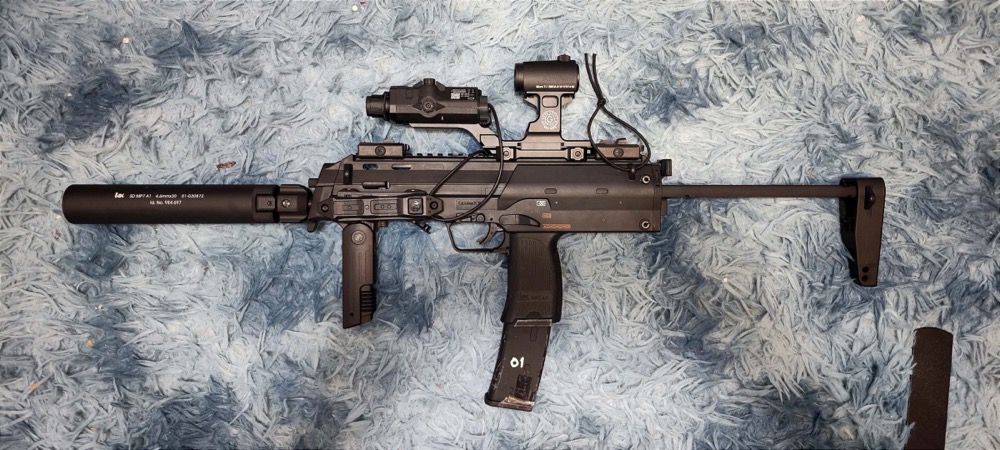
External accessories offer even more variety. The MP7A1’s full-length top Picatinny rail is perfect for mounting compact red dot sights. T1/T2-style micro red dots are the most popular pairing — lightweight and well-balanced without disrupting the gun’s handling. The short side rails accommodate tactical flashlights and laser units; in dimly-lit CQB venues, a flashlight is practically essential equipment.
Suppressors are another common addition. Using the included thread adapter, you can mount any 14mm CCW suppressor. A longer suppressor lets you hide an extended precision inner barrel inside, and it reduces mechanical noise somewhat (though the gas venting sound remains). Note that adding a suppressor shifts the center of gravity forward, which may require some adjustment during fast CQB transitions.
Prioritize upgrades in this order: precision inner barrel and hop-up bucking for accuracy first, then a red dot sight for faster target acquisition, and finally suppressors and cosmetic parts. Investing in components that directly improve your battlefield performance is always the smartest approach.
CQB Tactics with the MP7A1
The MP7A1 feels like it was purpose-built for CQB environments. Its compact profile prevents the gun from catching on walls and doorframes as you move through tight spaces, and its light weight lets you hold it at the ready for extended periods without fatigue. These seem like minor advantages on paper, but over a full day of games, they compound into something significant.
Room entry is one of the scenarios where the MP7 truly shines. Picture yourself stacked up beside a doorway, preparing to breach. With a full-length M4, you need extra clearance to swing through the door, and your barrel poking past the frame telegraphs your position. The MP7 is short enough that you can practically slide through while hugging the doorframe, with your muzzle already covering the room’s far corners. That one or two second advantage is often the difference between getting the kill and getting eliminated in CQB.
Full-auto mode is tempting indoors, but the smarter approach is using semi-auto as your default. The MP7A1’s semi-auto accuracy at close range is excellent — two or three rounds will handle most targets. Reserve full-auto for suppressive fire situations, like covering a teammate’s movement across an exposed corridor. If you spray full-auto all game, you’ll burn through those 40 rounds faster than you’d expect, and the cooling effect from rapid gas expansion will cause noticeable FPS drop toward the end of each magazine.
Magazine management deserves special attention with the MP7. A 40-round magazine empties in roughly 3-4 seconds on full-auto, and even semi-auto won’t last through many engagements. Carry at least 3-4 spare magazines as a baseline. GBB magazines are inherently heavy — filled with gas and BBs, a full loadout adds real weight. Invest in a quality magazine pouch or chest rig that allows fast, smooth reloads; this matters more than carrying a backup sidearm.
💡 Further Reading: For more CQB techniques, check out the Airsoft CQB Tactics Complete Guide.
Building Your MP7A1 CQB Loadout
When building a complete CQB loadout around the MP7A1, the philosophy is simple: stay light, stay fast. Skip the heavy plate carriers — a lightweight chest rig with just enough magazine pouches is all you need.
Face protection is your most important investment for CQB. Close-range engagements mean hits hurt significantly more than outdoors. A quality full-face mask like the Dye i4 or i5 is the go-to choice for many CQB players, offering wide visibility and excellent anti-fog performance. Gloves are also highly recommended — taking a point-blank hit to bare fingers is not a pleasant experience.
Footwear matters more than most players realize. Indoor field floors are typically smooth and sometimes slippery. A pair of indoor court shoes with good traction will serve you far better than heavy combat boots. You need the ability to sprint, stop short, and change direction quickly — not ankle support for trudging through mud.
If you’re serious about CQB, a tactical flashlight is nearly essential. Many indoor venues deliberately dim the lighting for atmosphere, and your red dot sight is useless if you can’t actually see your target. A 200-400 lumen compact light mounted on the MP7’s side rail not only illuminates opponents hiding in dark corners — the sudden burst of light itself has a brief blinding effect that gives you a decisive advantage.
💡 Further Reading: For complete loadout guidance, see the Airsoft Loadout Complete Guide.
Shot Timer Training Drills
Owning a great gun is just the starting point — training is what truly separates skilled players from the rest. The MP7A1 has several key skills worth practicing with a Shot Timer to measure your progress.
The first drill is the snap presentation. Start with the MP7 in a low-ready position (muzzle angled down 45 degrees), then raise, aim, and fire on the Shot Timer’s beep. Beginners typically take 1.5-2 seconds; the goal is consistent sub-1-second presentations. The MP7’s light weight gives it a clear advantage here — you’ll find it significantly easier to hit fast presentation times compared to a full-size M4.
The second drill focuses on reload speed. Use the Shot Timer to measure the full sequence: empty magazine, release, insert fresh magazine, rack the charging handle, and fire. The MP7A1’s magazine release button takes practice to operate smoothly — it’s not as intuitive as an M4’s. Target a complete reload in under 3 seconds.
The third drill is transition shooting. Set up two targets approximately 90 degrees apart and practice snapping between them. The MP7’s short profile generates almost zero rotational inertia during transitions, meaning you should be noticeably faster than with a longer gun. Use the Shot Timer to record split times between targets and track your improvement over time.
These drills don’t require a field — practicing manipulation drills at home with empty magazines is highly effective. Combined with techniques from the Dry Fire Training Guide, you can dramatically improve your weapon handling without spending a single BB or gram of gas.
Common Issues and Maintenance Tips
Daily maintenance on the MP7A1 GBB is straightforward, but a few areas deserve attention. After each session, run a cleaning rod through the inner barrel to clear residue, then apply silicone oil to moving parts to keep everything lubricated. O-rings are the most wear-prone components in any GBB — if you notice magazine gas leaks, replacing the O-ring set usually solves the problem.
Cold weather is the natural enemy of all GBB guns. When temperatures drop below 15°C (59°F), green gas vaporization efficiency drops noticeably, causing reduced FPS, weak blowback, or complete failure to cycle. In winter, keeping spare magazines in your jacket’s inside pockets — warmed by body heat — is a practical trick. If your area experiences harsh winters, you might consider running higher-pressure gas, though be mindful of the stress it places on stock internals.
While full-auto fire is undeniably fun, sustained use accelerates wear on internal components, particularly the loading nozzle and hammer assembly. If CQB gameplay is your focus, training yourself to default to semi-auto will not only conserve ammo and gas but also significantly extend your gun’s service life.
💡 Further Reading: For more firearm maintenance tips, check out the Pistol Cleaning & Maintenance Guide.
Final Verdict: The Perfect CQB Companion
The Tokyo Marui MP7A1 GBB isn’t a do-everything gun. Its FPS is modest, its range is limited, and it’ll get outgunned by M4s and snipers on large outdoor fields. But in its element — close quarters battle — very few airsoft guns can match its combination of maneuverability and controllability.
If you’re tired of getting your long gun caught on every doorframe and corner in CQB, or you want a weapon that’s ready to fight the instant you bring it up, the MP7A1 deserves serious consideration. From real-world special forces to airsoft fields around the globe, the MP7 has proven one thing: in the world of CQB, small and agile will always beat big and cumbersome.
Related Articles
- Airsoft CQB Tactics Complete Guide — Master indoor tactical techniques
- Tokyo Marui Hi-CAPA Complete Guide — Another top-tier CQB platform
- Airsoft Loadout Complete Guide — Gear configuration for every playstyle
- Shot Timer App Guide — Quantify your training progress
- Magazine Reload Techniques Guide — Advanced reload skills